

Puppies are curious little explorers, but sometimes their curiosity leads to some unpleasant habits like eating their own poop. While it may seem disgusting to us, this behavior, called coprophagia, is fairly common in young dogs and can stem from a variety of causes, from nutritional deficiencies to attention-seeking behavior. Understanding why your puppy does this is the first step toward addressing it effectively and keeping them healthy.
Preventing this habit early is key, as it can be difficult to correct once it becomes routine. With patience, consistency, and the right strategies, you can guide your puppy toward better behavior while ensuring their environment is safe and clean. In this guide, we’ll explore practical tips and techniques to stop your puppy from eating poop, making both training and daily life a little more pleasant for everyone.
Unpacking the Mystery Behind Coprophagia
Let's get the official term out of the way: it's called coprophagia. And while it’s one of the most baffling habits a puppy can have, understanding its roots is the first real step toward solving the problem. This isn't just a random act of grossness; it often comes from a place of instinct, a nutritional need, or even a simple behavioral quirk.
For a lot of puppies, this behavior is a weird little echo from their wild ancestors. In the wild, mother wolves kept their dens spotless to avoid attracting parasites and predators—a cleaning instinct that mother dogs still practice with their pups today. That instinct can sometimes get passed down to your curious puppy.
Quick Fact: A veterinary behavioral study found that about 16% of dogs are frequent poop-eaters, which suggests this ancestral link is a pretty strong one.
Common Reasons Your Puppy Eats Poop
While instinct is a major player, it’s not the only reason. Pinpointing the specific "why" for your puppy is crucial for creating a plan that actually works.
- Nutritional Gaps: Sometimes, a puppy’s diet is missing key nutrients or digestive enzymes. This can lead them to search for those missing elements in the most unappetizing place imaginable: their own stool.
- Boredom or Anxiety: A puppy left alone for too long without enough to do might resort to this habit out of sheer boredom. It can also be a sign of stress or a way to get a reaction—any reaction—from you.
- A Learned Habit: If a puppy was raised in an unclean environment or saw its littermates or mother doing it, they might have simply picked it up as a normal thing to do.
It’s so important to remember that this behavior is almost never malicious. Your puppy isn’t trying to be disgusting. Think of it as a puzzle to solve, not a crime to be punished. Shifting your mindset helps create a more compassionate—and much more effective—training plan.
Potential Health Concerns to Consider
Even though coprophagia is often behavioral, you have to rule out any medical triggers first. Certain conditions, like enzyme deficiencies or malabsorption issues, can leave undigested food in their feces, making it surprisingly appealing to them.
This is why a quick trip to the vet should always be your first move. Your vet can rule out any underlying health problems and make sure your puppy is on the right deworming schedule. After all, eating stool can expose your puppy to nasty parasites, which is why understanding the unseen dangers in dog poop is a must for every pet parent. A simple vet visit gives you peace of mind and starts you on the right path to stop a puppy from eating poop once and for all.
Your First Line of Defense: Management and Cleanup
Let's be honest, the fastest way to stop a puppy from eating poop is surprisingly low-tech: just get rid of it before they can. While you're working on the bigger training picture, immediate management is your single most powerful tool. It’s all about prevention, not confrontation.
Think of it like puppy-proofing your home. You don't scold a puppy for chewing on an electrical cord; you cover the outlet. Same logic applies here. By controlling the environment, you make it almost impossible for your pup to practice this gross habit in the first place.
This is a great breakdown of the "why" behind this behavior, which usually comes down to instinct, a health issue, or just a bad habit forming.
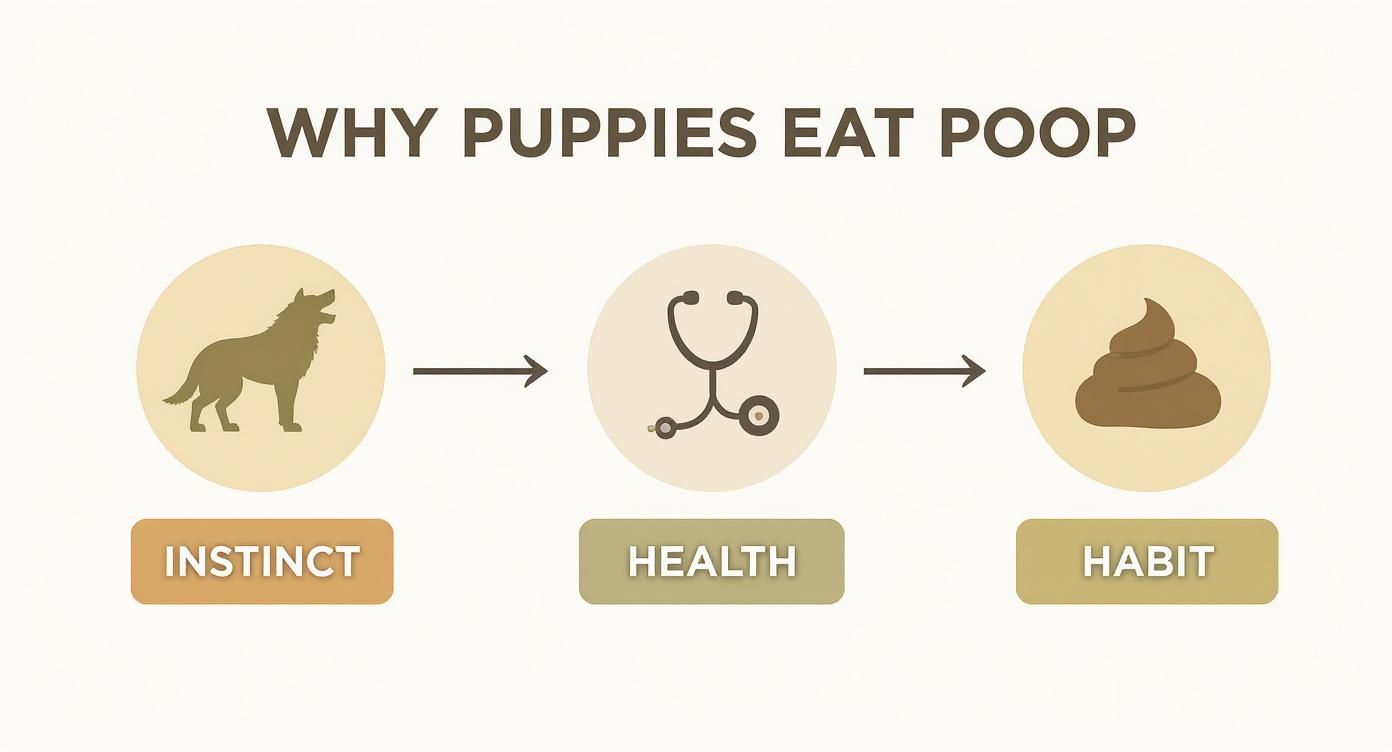
Figuring out if your puppy is acting on an old instinct or a new habit helps you decide on the best way to tackle it.
Master the Swift Cleanup
Your absolute number one job is to become a lightning-fast poop-scooping machine. The longer it sits in the yard, the more tempting it becomes for your curious pup. Your goal is simple: beat them to it, every single time.
This means you need to supervise all potty breaks, especially in these early days. Don't just open the back door and hope for the best. Go out with them, and the second they finish their business, cheerfully lead them back inside. Then, you immediately go back out and clean up.
The right tool makes this a thousand times easier and less disgusting. A portable device like Potomo’s clip-on pooper scooper is perfect for this, allowing for a quick, 100% hands-free pickup without you ever needing to bend down or touch anything. It’s not just about convenience—it's about the speed and consistency that will break this cycle. For more tips on getting your system down, check out our guide on responsible doggie waste disposal.
To make this a daily habit, here's a quick checklist to keep you on track.
Immediate Poop-Eating Prevention Checklist
| Prevention Tactic | Frequency | Key Benefit |
|---|---|---|
| Supervised Potty Breaks | Every single time | Prevents unsupervised "snacking" opportunities in the yard. |
| Immediate Yard Cleanup | Instantly after each potty break | Removes the temptation before the puppy even thinks about it. |
| Leashed Walks Only | Every time you leave your property | Gives you direct control to steer them away from other dogs' waste. |
| Body Language Watch | Constantly on walks | Allows you to redirect their attention before they investigate poop. |
| "Leave It" Practice | A few minutes daily | Builds a foundational command that has real-world applications. |
Sticking to these management steps provides a solid foundation, making any formal training you do much more effective.
Stay Vigilant on Walks
Walks are a whole different ballgame. You’re navigating a minefield of temptations left by other animals, and this is where your leash skills really shine.
Keep your puppy on a reasonably short leash, especially in high-traffic dog areas. This isn’t about restricting them; it’s about having the control to gently guide them away from a potential snack.
Pro Tip: Learn your puppy's "tell." A sudden stop with an intensely focused sniff is a dead giveaway they've found something. The moment you see it, use a cheerful "Let's go!" and a quick change of direction to redirect them before their brain even registers what they've found.
This isn't about yanking the leash or scolding. It's about being an alert, proactive leader. By staying tuned in, you steer them toward good choices and make walks a fun, stress-free experience for everyone.
Training Cues That Actually Stop the Behavior
While being a super-diligent poop-scooper is your first line of defense, training is what creates real, lasting change. Management prevents the act in the moment, but teaching your puppy what you want them to do instead is the long-term fix. This is how you empower your puppy to make the right choice, even when you’re not two feet away.
To get there, we need to focus on two of the most critical commands in any dog owner's playbook: a rock-solid "Leave It" and a lightning-fast recall, or "Come." Think of these as your verbal lifelines, pulling your puppy's attention away from a stinky snack and back onto you.
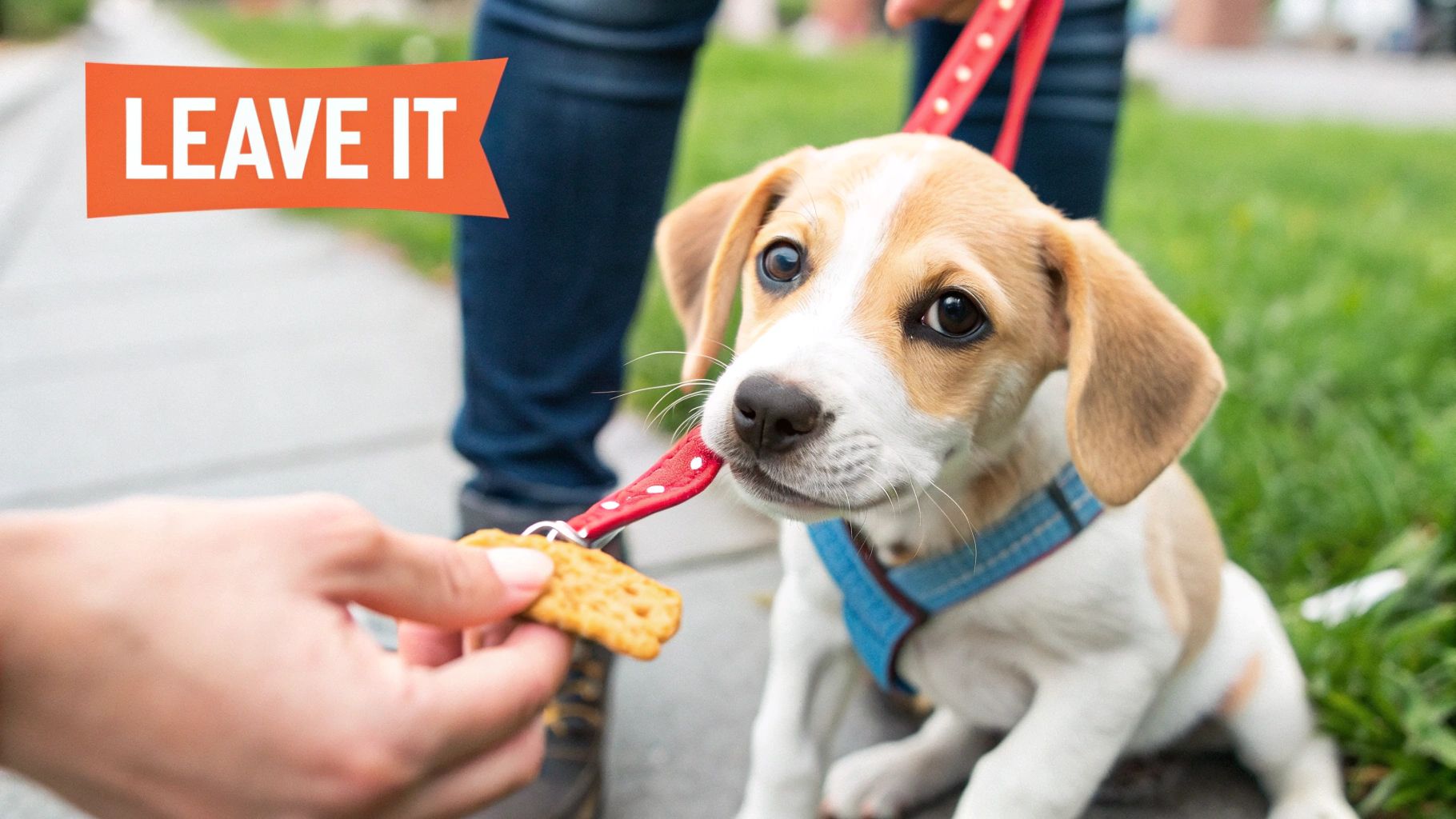
Building a Bulletproof "Leave It"
The goal here is simple: teach your puppy that ignoring something tempting on the ground gets them an even better reward directly from you. The secret is to start small and work your way up, setting them up for success at every single stage.
And please, never start by practicing with actual poop. That’s like asking a new driver to merge onto a six-lane highway during rush hour. Start easy, inside, with something boring like a single piece of their own kibble.
- Round One: Put a low-value treat (like kibble) on the floor and cover it with your hand. Your puppy will inevitably sniff or lick your hand. Say nothing. Just wait. The second they pull their head away, even for a moment, praise them like they just won an Oscar and give them a high-value treat (like a tiny piece of chicken) from your other hand.
- Round Two: Keep repeating this until your pup starts automatically backing away from your covered hand. Now you can add the words. Right before they pull back, say "Leave It" in a calm, clear voice. Then reward.
- Round Three: Time to raise the stakes. Uncover the kibble, but keep your hand ready to swoop in if they lunge. Over many sessions, you can slowly move to more tempting items and practice in different rooms or even the backyard.
The whole point is to make listening to you way more exciting than the forbidden treasure on the floor.
Remember, this is a game of patience. If your puppy messes up, it just means you've made it too hard, too fast. Just go back a step and build their confidence back up. Every success makes the command stronger.
Forging an Unbreakable Recall
A powerful recall is your ultimate safety net. You need your puppy to believe that running back to you is the absolute best thing they could possibly do at any given moment.
Just like with "Leave It," begin your recall training in a low-distraction zone like your living room. Use a high-pitched, excited tone and reward them like crazy every single time they come. And a critical rule: never, ever call your puppy to you for a punishment. That will poison the cue forever.
Once they've got it down indoors, take it outside on a long leash. Let them wander off a bit, then call them with a cheerful "Come!" and give them an amazing treat the instant they get to you. You're reinforcing the speed and enthusiasm of their return. This consistent practice builds a powerful habit that can override their instinct to investigate something gross. And of course, quick cleanups with a tool like Potomo’s pooper scooper mean there are fewer temptations in the yard to test their new skills in the first place.
The Role of Diet and Nutritional Supplements
While consistent training and quick cleanup are your front-line defense, what’s going into your puppy’s bowl can play a surprisingly important role. Think of it this way: if your puppy isn't digesting their food properly, undigested particles can pass into their stool, making it smell a lot like their last meal.
For a puppy exploring the world with their mouth, that can be an irresistible invitation. A quick diet check is a key part of a complete strategy to stop a puppy from eating poop for good.
The goal here is simple: make sure your puppy’s body is absorbing all the good stuff from their food, leaving nothing "interesting" behind in their waste. That all starts with a highly digestible, high-quality puppy food.
Choosing the Right Puppy Food
Walking into a pet store and facing a wall of food bags can feel overwhelming. It’s easy to just grab the one with the cutest dog on it, but a little label-sleuthing goes a long way.
Flip the bag over and look at the ingredients. You want to see a whole protein—like real chicken, beef, or fish—listed as the very first ingredient. Try to steer clear of foods that lead with fillers like corn or vague "meat by-products," as these are often tougher for a young puppy's digestive system to handle.
- Digestibility is Everything: When food is easily broken down and absorbed, fewer nutrients are passed into the stool as waste. Less "leftover" food in the poop means it’s far less tempting.
- Chat With Your Vet: Before making any big dietary changes, it's always smart to talk with your veterinarian. They know your puppy's specific needs and can recommend brands that are a great fit for their breed, size, and health.
Supplements and Food Additives
You’ve probably seen them online or on pet store shelves—products marketed as a quick fix for poop-eating. These are usually powders or chews designed to make a dog's stool taste awful. Many contain ingredients like yucca, chamomile, and various digestive enzymes.
Digestive enzymes, for example, can genuinely help your pup’s system break down fats, proteins, and carbs more efficiently. Better nutrient absorption means less appealing waste.
But it’s really important to have realistic expectations. These products are not a magic cure. They work best as one piece of a much larger puzzle that includes diligent cleanup, consistent training, and a high-quality diet.
Think of these supplements as a helpful assistant, not the whole solution. If you’re already managing the environment and reinforcing good behaviors, an additive might just be the extra nudge your puppy needs to finally decide poop is off the menu.
Frequently Asked Questions About Diet and Coprophagia
1. Should I add pineapple or meat tenderizer to my puppy's food?
These are old-school home remedies you’ll see all over the internet, but their effectiveness is purely anecdotal and not backed by any real science. Some additives, like meat tenderizer, are high in sodium and can cause an upset stomach. It’s always safer to stick with products specifically made for dogs and approved by your vet.
2. How long does it take for a diet change to work?
If a nutritional issue is the root cause, you might see an improvement within a few weeks of switching to a better food. But since coprophagia is so often a deep-rooted habit, diet alone rarely solves the problem. Consistency across all your efforts—training, diet, and cleanup—is what truly makes the difference.
3. Can food allergies cause a puppy to eat poop?
There isn't a direct, proven link, but food allergies often cause gut inflammation and digestive upset. This can absolutely interfere with how well a puppy absorbs nutrients. If you suspect an allergy—maybe you’re seeing itchy skin, chronic ear infections, or digestive issues—talk to your vet. Getting a proper diagnosis and a new diet plan could be a critical step.
Solving Boredom and Anxiety Triggers
Sometimes, the real reason your puppy is eating poop has less to do with their stomach and more to do with what’s going on in their head. A puppy without a "job" will often invent one for themselves. Unfortunately, that self-appointed job can easily become scavenging.
This behavior is often just a symptom of a deeper issue, like boredom, stress, or even a simple cry for your attention.
It helps to look at your puppy's world from their perspective. Is their day just a predictable cycle of naps and potty breaks? Or is it filled with interesting challenges and things to do? A mentally tired puppy is a happy puppy—and one who is far less likely to pick up a gross habit like this one.
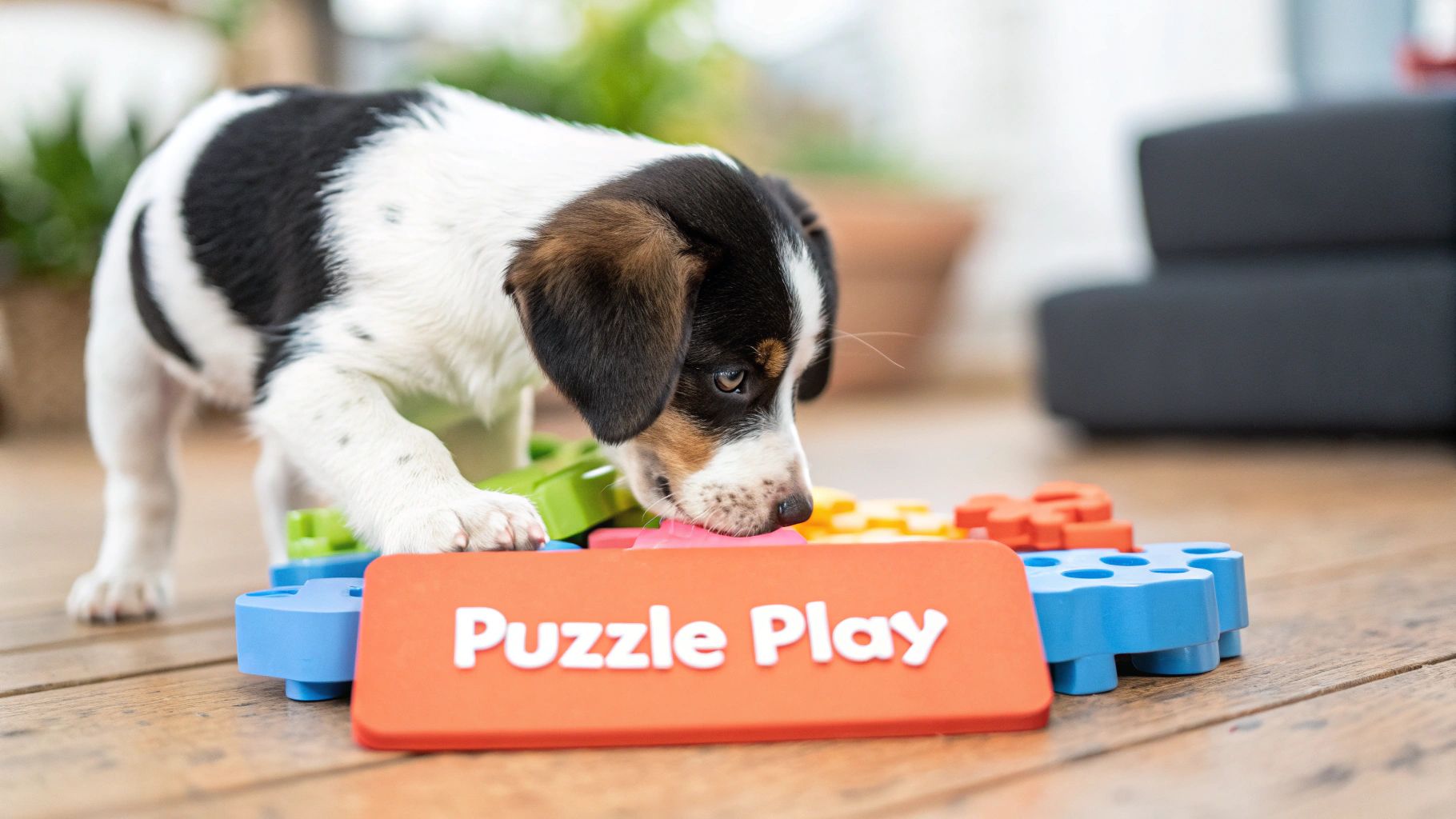
Evaluating Your Puppy's Daily Enrichment
If you notice your puppy is constantly on the hunt for things to chew or eat, it's a huge red flag that they need more constructive ways to use their energy. Research from the University of California, Davis, actually points out that anxiety and boredom can trigger coprophagia, a behavior seen in 24% of dogs at least once in their lives.
This might even connect back to the scavenging instincts of their ancestors, who ate whatever was available just to survive. You can learn more about the behavioral science behind why dogs eat poop.
A quick enrichment checklist can help you spot any gaps in their daily routine.
- Interactive Toys: Are puzzle toys and snuffle mats part of their everyday life? These aren't just toys; they’re tools that make your puppy think and problem-solve to get their food, which is incredibly satisfying for them.
- Training Games: A couple of short, fun training sessions (just 5-10 minutes) each day can do wonders. Practicing "sit," "stay," or a fun new trick keeps their brain firing and makes your bond even stronger.
- Varied Exercise: Is every walk the exact same route? Try mixing it up. New locations, letting them have a good "sniffari" in a safe area, or even trying a gentle hike gives them a ton of much-needed mental stimulation.
A simple "find it" game is a brilliant way to redirect those scavenging instincts. Just hide a few high-value treats around a room and encourage your puppy to use their nose to track them down. It gives them a positive outlet for that natural foraging drive.
Creating a Calm and Predictable Environment
Just like us, puppies thrive on routine. A predictable schedule for feeding, potty breaks, and playtime helps lower their anxiety because they know what to expect from their day. When a puppy feels secure, they're much less likely to develop habits born from stress.
Keeping the yard clean is a massive part of creating a calm, temptation-free zone. A quick, hygienic cleanup routine with a tool like Potomo's clip-on pooper scooper means there’s one less thing for a bored or anxious puppy to fixate on.
By managing their environment and enriching their minds, you’re doing more than just stopping a bad habit—you’re building a happier, more well-adjusted dog.
Frequently Asked Questions: Stopping a Puppy from Eating Poop
When you're dealing with a puppy who eats poop, it's natural to have a lot of questions. Let's get straight to the answers for some of the biggest concerns that come up.
Why did my puppy suddenly start eating poop?
A sudden start can often point to a specific trigger. Consider what might have changed recently. Have you switched their food? Has their daily routine been disrupted? Is there a new source of stress at home? It could also signal a new nutritional deficiency. A sudden change is a great reason to check in with your vet to rule out any medical issues first before exploring behavioral causes.
Can I punish my puppy to stop them from eating poop?
This is a really common first instinct, but punishment is almost guaranteed to make things worse. Scolding your puppy or running towards them frantically often creates a cycle of fear and anxiety. Worse, it can damage your bond or even turn the behavior into a weird game where they get a big reaction out of you. Many puppies who are punished just learn to be faster and sneakier about it. Instead, focus on positive reinforcement by teaching "Leave It" and rewarding your puppy for ignoring the poop.
Will my puppy just grow out of this habit?
While some puppies might drop the habit as they mature, you absolutely cannot count on it. For many dogs, coprophagia becomes a deeply ingrained behavior if it isn't managed from the start. The more your puppy gets away with it, the harder it will be to stop later on. A 2018 survey revealed that 16% of dogs are 'frequent' poop eaters, showing that it can easily stick around for life. You can learn more about the evolutionary roots of this behavior on LiveScience.com. Consistent management—which means cleaning up immediately—and dedicated training are the only reliable solutions.
How dangerous is it for my puppy to eat poop?
Thankfully, it's often more disgusting than it is dangerous, but there are real health risks involved. Your puppy can easily pick up intestinal parasites like roundworms, whipworms, or giardia by eating the feces of other animals. Eating their own stool is less risky, but it can lead to a cycle of reinfection if they already have parasites. It's always a good idea to keep your puppy on a regular deworming schedule with your vet and to mention this behavior during their checkups. For more detailed answers, you can also check out our comprehensive guide in the Potomo FAQ section.
A consistent cleanup routine is your strongest tool in this process. PoTomo makes it simple with a 100% hands-free scooper that clips right to your leash, so you're always ready to remove temptation instantly. Make every walk cleaner and easier by visiting https://potomo.net to get yours.