

Walking more than one dog at a time can feel like a chaotic circus act—tangled leashes, competing personalities, and unexpected bursts of energy can make even the most experienced dog owner feel overwhelmed. Managing multiple dogs on a single walk requires strategy, patience, and a few practical tricks to keep everyone safe and under control. Whether you’re a dog parent to a lively duo or a handful of furry friends, understanding how to navigate these walks can turn a stressful routine into a more enjoyable experience for both you and your dogs.
From selecting the right equipment to mastering leash techniques and reading your dogs’ body language, there are several approaches that make multi-dog walks smoother and more fun. This guide will cover essential tips and strategies to help you maintain control, reduce tension, and actually enjoy the time spent outside with your four-legged companions. With the right preparation, walking multiple dogs doesn’t have to be a battle. It can become a rewarding and energizing part of your day.
Taming the Tangle Before You Start
Let's be honest, walking a whole crew of dogs can feel like you're trying to wrangle a furry hurricane. The good news? Turning that chaos into a controlled, pleasant stroll isn't about brute strength—it's about smart strategy. This guide offers the real-world techniques that seasoned multi-dog owners and professional walkers actually use to keep their walks peaceful and productive.
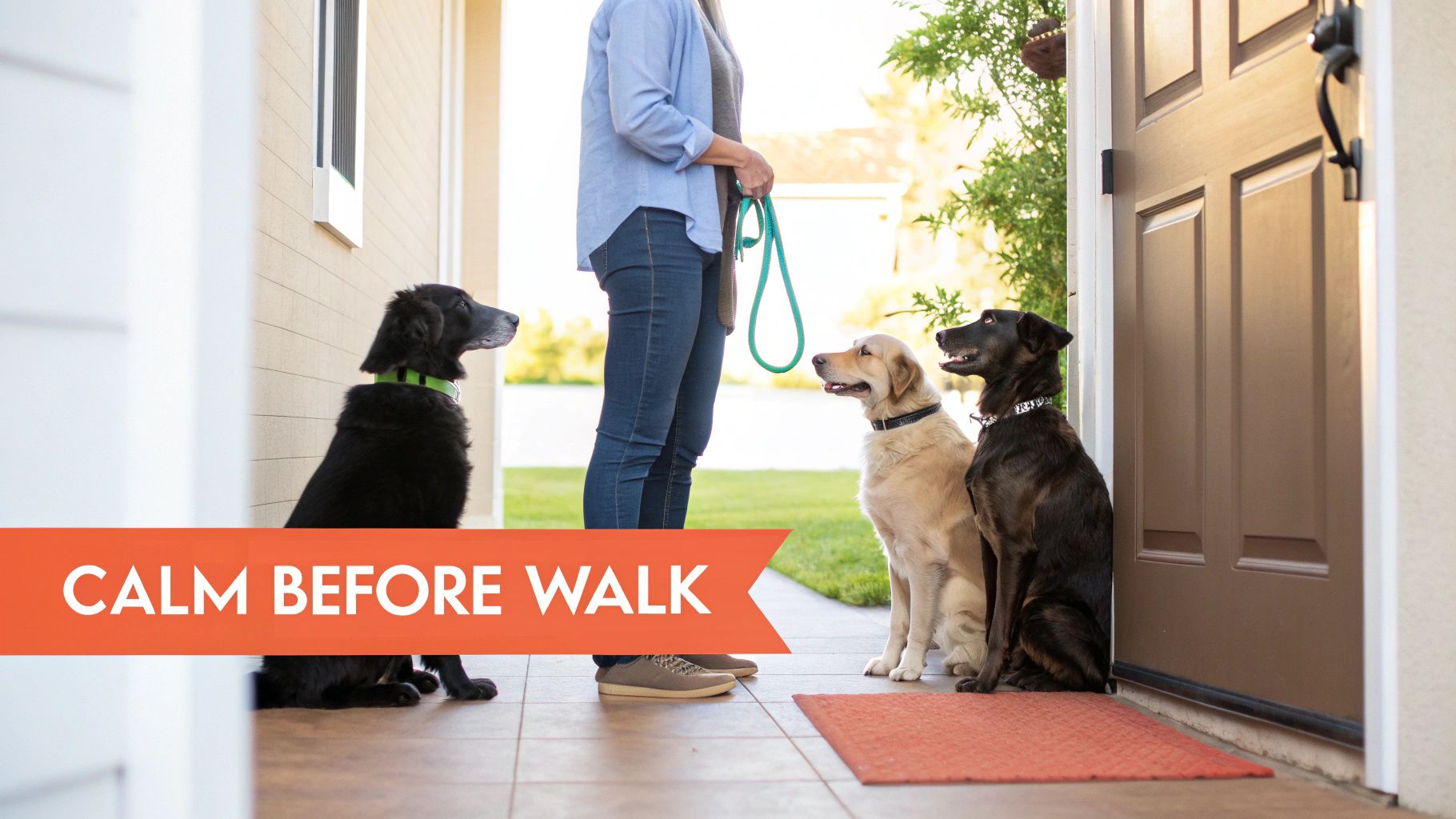
We’re going to help you shift your mindset from simply managing a bunch of dogs to truly leading a cohesive pack. And it all begins before you even clip on the leashes.
The Foundation of a Good Group Walk
A successful group walk starts with understanding your pack's unique dynamic. Every dog has its own personality—some are bold and pushy, others are more cautious and hang back. Knowing who's who is the first step to creating harmony on the leash.
A few core principles will set you up for success:
- Individual Skills First: You can't expect your dogs to walk well together if they can't walk well alone. Each dog needs to master loose-leash walking one-on-one before you even think about grouping them up. This is non-negotiable!
- Energy Management: A quick pre-walk ritual can work wonders. A few minutes of practicing "sit" or "stay" helps burn off that initial burst of frantic energy, putting your dogs in a much calmer, more focused mindset.
- You're the Leader: Your dogs are constantly looking to you for cues. If you're stressed out and yanking on the leashes, they'll feed off that tense energy. Remember, a calm owner makes for calm dogs.
A peaceful multi-dog walk isn't a myth—it's an achievable goal with the right approach and consistent practice.
Of course, there are practical things to consider, too, like cleanup. Juggling multiple leashes while trying to handle waste bags is a special kind of challenge. That’s why having an efficient system is a game-changer. For more tips that are especially helpful for multi-dog households, check out our guide on the best way to pick up dog poop.
Choosing Gear That Actually Helps
Walking more than one dog at a time is an art, and your equipment is your set of brushes. The right gear can make the difference between a chaotic, tangled mess and a smooth, enjoyable stroll. Getting it wrong means sore hands, frustrated pups, and a feeling of being pulled in ten directions at once.
Let’s be real—the goal isn't just about restraint. It's about clear communication and keeping everyone safe and comfortable. The tools you choose should be an extension of you, matching your dogs' unique sizes, temperaments, and walking styles.
Harnesses vs. Collars for Group Walks
When you're managing a pack, no-pull, front-clip harnesses are an absolute game-changer. A traditional collar can put a dangerous amount of pressure on a dog’s trachea if they pull—a risk that multiplies with more dogs. A front-clip harness, on the other hand, gently redirects their forward momentum.
Picture this: one of your dogs spots a squirrel and lunges. With a collar, that jolt goes straight to their neck and up your arm. With a front-clip harness, that same lunge simply turns them back toward you, breaking their momentum without the choking or gagging. It's a much safer and more effective way to manage sudden movements.
Quick Fact: A well-fitted harness spreads pressure across the strongest parts of a dog’s body—their chest and shoulders. This seriously reduces the risk of neck injuries, which is a huge relief when you’re navigating the unpredictable dynamics of a group walk.
Leashes, Leashes Everywhere
There’s no magic leash that works for every multi-dog household. The best setup is the one that works for your specific crew.
A good way to figure out what you need is to look at the most common options and see what fits your pack's personality.
Your Multi-Dog Walking Gear Comparison
A quick look at common equipment to help you pick the right tools for your specific pack.
| Gear Type | Best For | Pros | Cons |
|---|---|---|---|
| Separate Leashes | Dogs of different sizes, speeds, or training levels. | Maximum individual control over each dog. | Can become a tangled mess; requires more hand strength. |
| Leash Couplers | Two dogs of similar size and walking pace. | Instantly eliminates tangles; frees up one hand. | Dogs must walk well together; less individual control. |
| Hands-Free Leashes | Well-trained dogs with good leash manners. | Frees up both hands for treats, balance, or cleanup. | Not ideal for strong pullers or reactive dogs. |
Choosing the right combination of these tools will make your walks far more manageable and give you the confidence to handle your crew like a pro.
Of course, even with the perfect leash system, cleanup can still throw a wrench in things. Fumbling with a poop bag while trying to hold onto multiple leashes is a classic juggling act nobody enjoys. This is where a tool like Potomo’s pooper scooper comes in handy. Its smart, one-handed design means you can handle the mess without ever letting go of the leashes, making a tricky situation simple and clean.
For more ideas on making cleanup a non-issue, check out our guide on modern doggie waste disposal.
Mastering Leash Handling and Positioning
Alright, this is where the rubber meets the road—or, more accurately, where the leashes meet your hands. Holding onto multiple leashes shouldn't feel like you're wrestling an octopus in a windstorm. It's all about technique. With a few adjustments, you can turn that jumble of straps into a calm, controlled system that works for you and your pack.
The whole point is to move beyond simply holding on for dear life. You want to actively communicate with your dogs through the leash. This creates a predictable structure for the walk, which builds confidence in both you and them.
Finding Your Grip
How you hold the leashes really does set the tone for the entire walk. It’s your main point of control. First rule: stop wrapping them around your wrist. That’s a major safety hazard. Instead, let's get a little more strategic.
- The Accordion Grip: Hold the leashes in a series of folds in your hand. This lets you quickly give slack or gather it back in without fumbling around, giving you precise control over each dog's distance.
- One Dog Per Hand: Simple, but effective, especially if you only have two dogs. It pretty much eliminates tangles and lets you give individual corrections or praise without confusing anyone. My neighbor does this with his two Labs, and they walk in perfect sync.
- The Middle Finger Split: If you need to hold two leashes in one hand, try this. Place one leash over your index finger and the other between your middle and ring fingers. It keeps them from twisting into a mess and gives you surprisingly good independent control.
Here’s a quick visual of how your gear choices all come together, from the harness on your dog to the leash system you’re holding.
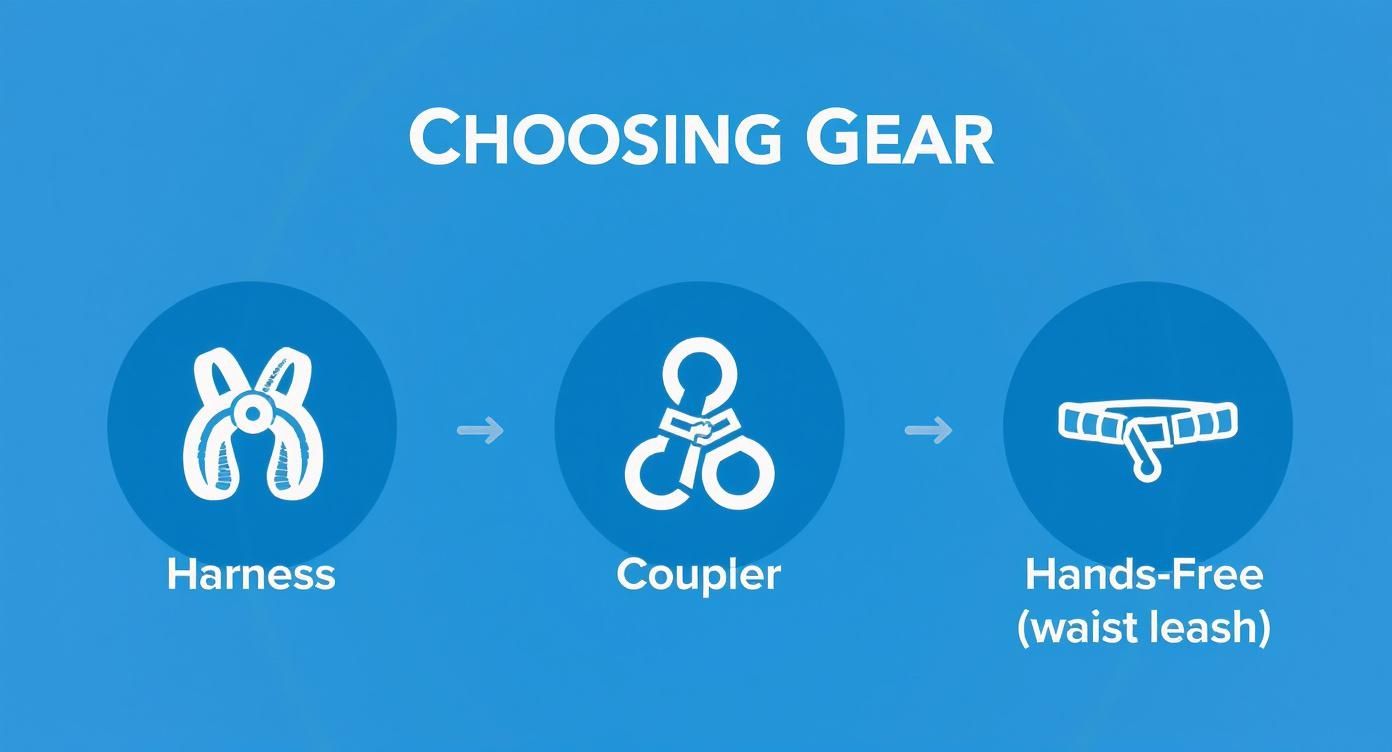
You can see how each piece builds on the last to create a walking setup that's secure and, most importantly, manageable.
Establishing the "Heel Zone"
The "heel zone" is that sweet spot right beside your leg where you want your dogs to walk. Consistently keeping them there reinforces you as the leader and stops them from dragging you in every direction. This isn't about rigid, formal obedience training; it’s about creating a cohesive team that moves together.
Think about it: when your dogs are in a heel, you can navigate a busy sidewalk as a streamlined unit, not a wide, chaotic cluster.
Start practicing this in a quiet place with few distractions, like your backyard or a park during off-hours. Use treats and tons of praise to reward them for staying in that zone, even if it's just for a few seconds at first. It all adds up.
Interestingly, the professional dog walking services market has exploded, and these pros rely on these exact positioning techniques for safety and efficiency. App-based platforms have helped them manage complex routes with multiple dogs, and it all comes down to control. You can read more about trends in the dog walking industry and see how the pros are handling their packs.
Key Takeaway: Your calm energy and clear leash communication are your most powerful tools. Dogs are incredibly perceptive; if you're tense and anxious, they will be too. Take a breath, stay relaxed, and focus on providing confident, gentle guidance.
Training Your Dogs to Walk as a Team
A fantastic multi-dog walk is won long before you ever step outside. It all starts inside your home, with some foundational work that teaches your dogs to see the walk not as a chaotic free-for-all, but as a team activity with you as the calm, confident leader.
This process is all about building a cooperative mindset. That harmony you're dreaming of on the leash? It begins in the living room.
Think of it this way: you can't expect your dogs to walk politely together if they haven't first learned how to walk politely on their own.
Start with Individual Mastery
Before you even think about clipping multiple leashes together, each dog has to nail loose-leash walking on their own. This is the non-negotiable first step. A dog that pulls, lunges, or zig-zags by itself will only become a super-charged version of that when the energy of another dog is added to the mix.
Keep your practice sessions short and positive with each dog separately. The goal is simple: the leash should have a nice, gentle "J" shape hanging between you and your dog. The second you get that slack leash, reward them with quiet praise or a tiny treat.
This one-on-one time builds a strong connection and makes sure each dog really understands what you're asking, without the distraction of their furry siblings.
Pre-Walk Rituals for Calm Departures
Let's be honest, the moments right before a walk can be pure chaos. Dogs get amped up, and that frantic energy almost always spills over onto the sidewalk. Your job is to create a pre-walk ritual that’s boringly calm.
- Doorway Manners: This is a big one. Teach your dogs that the door only opens when they are calm. If they rush it, you simply close it and wait. Ask for a "sit" and only open the door when you have a row of patiently sitting dogs.
- Leashing Up Calmly: The sight of a leash can trigger a frenzy. If they start jumping and getting wild, just put the gear away and try again in a few minutes. This quickly teaches them that calm behavior is what makes the walk happen.
Quick Fact: The professional dog walking industry, valued at over $1.3 billion in 2023, is built on these exact principles of control and routine. The pros know that a calm start is the secret to a safe group walk. You can discover more insights about dog walking statistics to see just how essential these practices are.
Reinforcing Key Commands
Once each dog is walking nicely alone, it's time to sharpen a few key commands that will be your lifeline on a group walk. These are your tools for managing the real world.
- "Watch Me": Think of this as your reset button. Use a high-value treat to teach your dogs that making eye contact with you is the best thing ever. Practice this randomly throughout the day, so it becomes a rock-solid way to get their attention back when a squirrel makes a sudden appearance.
- "Leave It": This one is a non-negotiable for sidewalk safety. "Leave It" teaches your dogs to ignore all the tempting (and disgusting) things they might find, from dropped pizza crusts to mystery trash. Start easy by rewarding them for ignoring something boring on the floor, and slowly work your way up to more tempting things.
Once these skills feel solid, you can start taking very short, successful walks together around the block, gradually making them longer. Remember, every single calm walk is a huge win that builds the foundation for the next one. Positive reinforcement is your best friend here, teaching your pack how to move as a happy, cohesive team.
Handling Common Problems on the Path
Let's be real: even with the best gear and a well-trained crew, a walk with multiple dogs is never going to be 100% predictable. That sudden lunge at a squirrel, the inevitable leash tangle when one dog stops to sniff, or that heart-stopping moment a high-energy, off-leash dog comes bounding toward you—these are the moments that test your mettle.
The goal isn't to avoid these things entirely, because you can't. It's about having a game plan so you can handle them calmly and confidently when they happen.
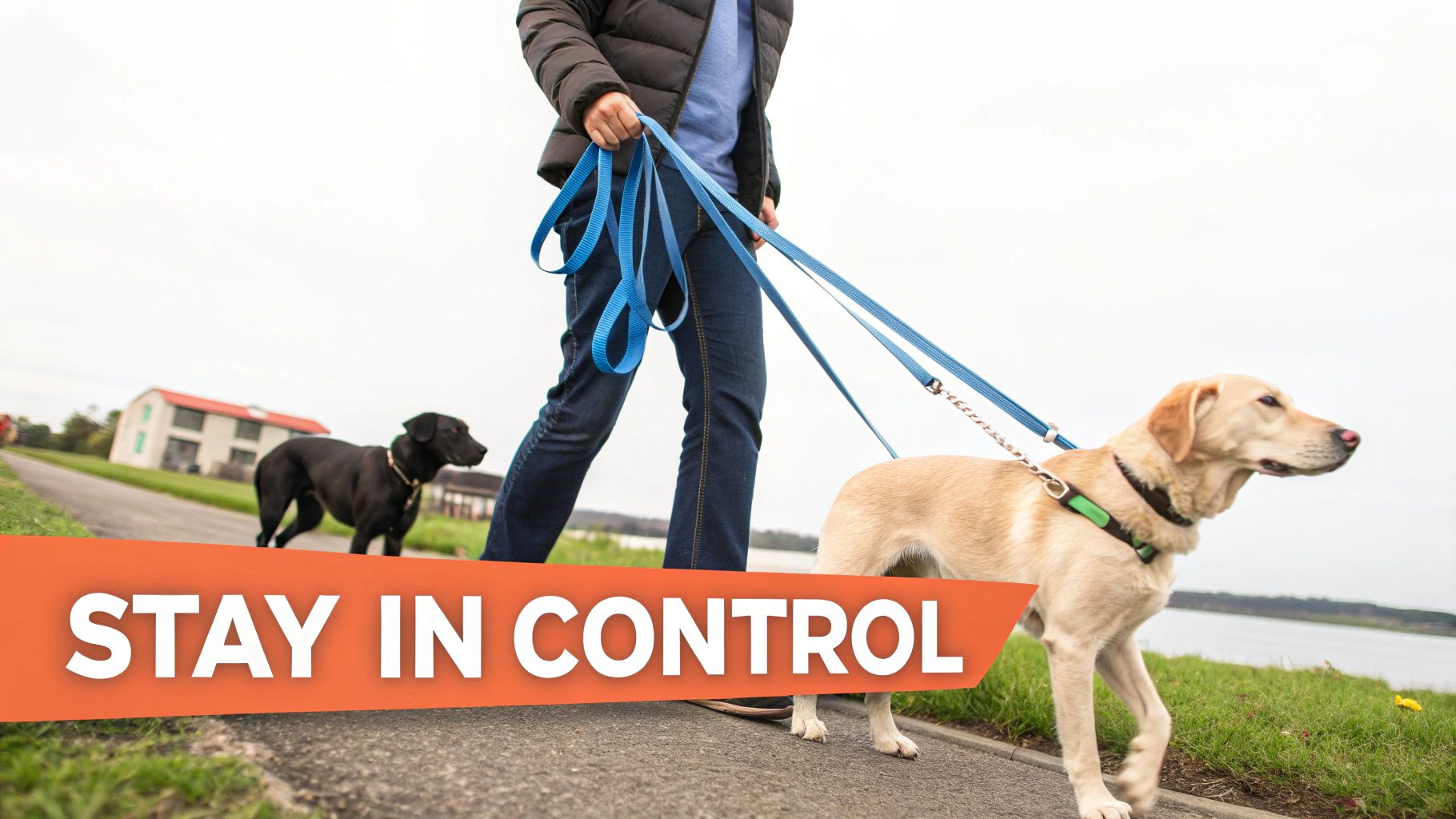
Think of it as your troubleshooting guide. For example, if one dog lunges, your go-to move should be a quick, calm U-turn, leading the whole pack away from the trigger. It's a simple action that instantly shifts their focus back to you and reminds them who's in charge.
Managing Different Energy Levels
One of the most common struggles is dealing with dogs who have completely different ideas of what a "walk" means. What do you do when your young terrier wants to break the sound barrier, but your senior basset hound is on a mission to sniff every single blade of grass?
It's a recipe for pulling, frustration, and a tangled mess.
- Walk Them Separately: Sometimes, the easiest solution is the most effective. Giving each dog a dedicated walk that fits their energy level can be far more rewarding for them and a whole lot less stressful for you.
- Strategic Positioning: If you have to walk them together, put the slower dog on the side closest to you, right in that "heel zone." This gives you direct control over their pace and stops the faster dog from dragging them along.
Quick Tip: Before you even leave the house, try a few minutes of intense playtime with your high-energy dog. A quick game of fetch can burn off that initial burst of excitement, making them much more likely to walk at a relaxed pace with their slower buddy.
The Cleanup Conundrum
And then there's the inevitable poop stop. Trying to juggle multiple leashes while fumbling with a flimsy poop bag is a special kind of nightmare. All it takes is one dropped leash for a simple cleanup to turn into a serious safety hazard.
This is where your choice of tool really matters. A device like Potomo’s pooper scooper was built for exactly this situation. Its one-handed, clip-on design is a game-changer. You can keep a solid grip on all your leashes with one hand while you cleanly and quickly scoop everything up with the other.
No bending, no fumbling, and most importantly, no compromising your control over the pack. Proper cleanup is a huge part of being a good dog owner and neighbor, a topic we dive into in our guide to the unspoken rules of dog poop etiquette.
Finally, a great walk ends with a calm entry back home. Teach your dogs to sit and wait at the door before you all go inside. Take off their gear in a quiet, orderly way to reinforce that calm energy and ensure the peace from your walk follows you inside.
Frequently Asked Questions About Walking Multiple Dogs
Even with the best game plan, walking a whole crew of dogs can throw you some curveballs. To help you feel more prepared, we’ve rounded up some of the most common questions from multi-dog households.
What do I do if my dogs all pull in different directions?
This is the classic multi-dog tug-of-war! The solution starts before you even leash them up together. Each dog must first master loose-leash walking on their own. Once you're out, if they start to pull apart, your best move is a quick, calm U-turn. Simply pivot and walk the other way. This breaks their focus and teaches them that pulling gets them the opposite of what they want.
Is a leash coupler (splitter) a good idea?
A leash coupler can be a lifesaver if you have two dogs of similar size and walking pace, as it eliminates tangles and frees up a hand. However, it's a poor choice for dogs with different energy levels (like a speedy terrier and a slow-sniffing basset hound). For mismatched pairs, separate leashes are the only way to maintain individual control.
How do I safely add a new dog to our group walks?
Patience is key. Start by walking the new dog completely alone to build a bond and work on their individual leash skills. Next, have a friend walk the new dog while you walk your original pack, keeping a safe distance between them ("parallel walking"). Over several walks, gradually decrease the distance as long as everyone remains calm. Only when they can walk peacefully side-by-side should you try walking them all together yourself.
How can I possibly clean up poop while holding multiple leashes?
Juggling leashes while fumbling with a poop bag is not just awkward; it's a safety risk if you have to let go of a leash. This is where having a purpose-built tool makes all the difference. A one-handed pooper scooper like Potomo’s allows you to keep a secure grip on all your leashes with one hand while you easily scoop and bag waste with the other. It turns a stressful moment into a simple, clean, and safe task.
Walking your pack should be one of the best parts of your day, not a stressful chore. When you have the right techniques and the right tools, you can lead your dogs with confidence. The Potomo pooper scooper is specifically designed to make one of the trickiest parts of the walk simple and stress-free.
Ready for an easier, cleaner walk? Get your PoTomo today.